Wednesday, April 11, 2018

Note to my 17 year old self on the eve of my 57th birthday


Hey my dear Sandie,

I can see you now on the threshold of Class XII, anxious and unhappy, in a school you are a misfit in, wondering if you are ever going to be successful. You’re worried about the future, the kind of friends you will find and the life choices you will make. You wish you could see yourself many years from now, and see what you have become as that would help you decide your next few choices.  Well, unfortunately you cannot do that, but I just want to tell you that you did good.

You did say ‘yes’ to the right life partner – someone who will give you the space to grow without feeling threatened, someone who will take pride in your success and will always be there to support you in the decisions you make.  While your life will not be as unconventional as you hope it would be, it will still be far from ordinary. You will be happy – believe me, as you grow older, you will realise how important that is, and how blessed you will feel to actually be able to say you are happy.

You will have two wonderful sons who grow up to be very fine young men, caring about the environment and the world we live in. You will have a daughter-in-law who is a very special member of your family.

You will have a wonderful relationship with your sister. She will be a wonderful companion and you will become close friends. You will also have a very loving extended family and feel very wanted and appreciated. You will get to spend a lot of time with your mother, and enjoy the interactions with her. Her eagerness to learn, love for the fine things in life and her perseverance will be values you will  appreciate and imbibe, and your life will be more special thanks to that.

You will have wonderful friends – some who you have already met -  and luckily for you, you will have enough time to invest in these friendships and each of these friendships will be precious.   You may not become a high-flying career woman, but you will have done some productive work, and surely have a positive impact on many people’s lives. 

You will be an avid knitter, crocheter and quilter (don't look so surprised) and your family and friends will really appreciate all the work you will gift them. You actually manage to travel a lot (Paris and Angkor Wat being just two of the beautiful places you will visit), go on a terrific tiring but satisfying trek, so don't look so wistfully at pictures of the mountains. You will even run/walk a 10K marathon, thrice!! Countless plays and music concerts are coming up in the future, so you don't have to pore over the events pages of the newspapers so sadly and regretfully.

As you can see, life will be great. The future is not scary – you grow up to be a thinking woman with a solid head on your shoulders; if the head sometimes tends to drift among the clouds, the feet are still planted firmly on the ground so you will be ok. Don’t worry so much about your life ahead, and …. stop biting your nails!

Sunday, February 4, 2018

Vipassana - 1st October to 12th October, 2017

Vipassana - 1st October to 12th October, 2017

I first heard of Vipassana when the film actress Amala spoke about a course she attended where everyone maintained silence for 10 days. For some reason, the idea appealed to me. After that, I came across information about the course off and on but I just did not seem to find the most convenient time for a course.

2016 November had seemed like a good time to plan to attend the 12 day session in Dharamkot near Dharamshala, and I was very pleased when my application got approved. I had chosen to attend the course at Dharamkot as I was eager to be able to spend 12 days in the mountains, and the weather in October/November would hopefully not be too cold for me. The form for application for a session is normally enabled only for a couple of days before the centres get the allowed number of applicants, so being able to apply and actually getting a confirmation is quite a feat. However, the ITC Retirement Programme was scheduled around the same time, and as that was not going to be offered to us every year, Ravi and I chose to go to Agra, and I cancelled my confirmation. This year, I sent in my application on 31st August, while in the Calcutta Airport, before boarding a flight for Paris. Not having been able to attend the programme last year, I was really thrilled when I received the mail from the Centre at Dharamkot, confirming my attendance from October 1st to October 12th.  The advantage of Dharamkot as a location was that I would also get to spend time with the family in Delhi.

I left for Delhi on 30th September which was Vijaya Dashami day. It really felt very strange leaving Shashank, Kanishk and Supriya behind in Cal with Ravi. I went straight to Usha’s place, and then in the evening, took the bus from ISBT to Dharamshala.  At the bus stop, I got chatting with a young woman, Vaishali, and it turned out that she was also going to Dharamkot for the same Vipassana programme.

On 1st morning,  both of us got into a cab that took us up to Dharamkot, right up to the gate of the Centre, charging us 200/- each. The time was only 6.30 am and we were obviously the first two participants entering the place. An elderly caretaker showed us to the ladies’ section of the center, and asked to freshen up in any of the rooms there.


     Entrance                                      Office                                        Registration


He said our rooms would be allotted to us only after the office opened at 9, and breakfast would be available from 8 a.m. in the dining hall.  Lunch would be served around 12.30.


The Dining hall was two floors above the office, and the A wing of the rooms was another floor above. It really felt like it was very far away when we lugged our suitcase up the stairs to the rooms.  The room was a very tiny one, with a folding bed with nylon tape, and a thin mattress. There were two blankets folded up neatly but no cover for the mattress or the pillow. We were told that these would be given to us after registration, when the rooms were allotted. The room I used looked damp but it at least had an attached toilet, albeit very tiny. I just decided to suspend all judgement till I was allotted what would be my accommodation for the next 10 days.

I spent a major part of the morning sitting in a tiny café outside the Center, having lots of black tea and watching the tourists – as it was the start of a long weekend, there were lots of backpackers and carloads of tourists heading for Triund, the peak which was visible from Dharamkot.

The participants started trickling in post lunch, and registration forms were filled. We were assigned individual laundry bags and lockers to keep away our phones, all writing and reading material and anything else that could possibly distract us from the meditation practice. I had a choice of either sharing a room with another meditator and having an attached bath, or a single room with the common bathing area. Since I had seen the clean (except for cobwebs) toilets and bathrooms, I chose to have a single room.


Corridor with rooms oleftA


     A Block entrance                                      Corridor with rooms                                    Twin sharing room

I helped myself to an extra blanket from the common storage area in anticipation of it becoming colder, as it started drizzling during the evening.  The printed pillow cover and sheet was not something I would have ever chosen, and the mattress was torn in the edges but I decided to be calm and bear with it – one of the good points of being an observer rather an active participant, I guess.
                              

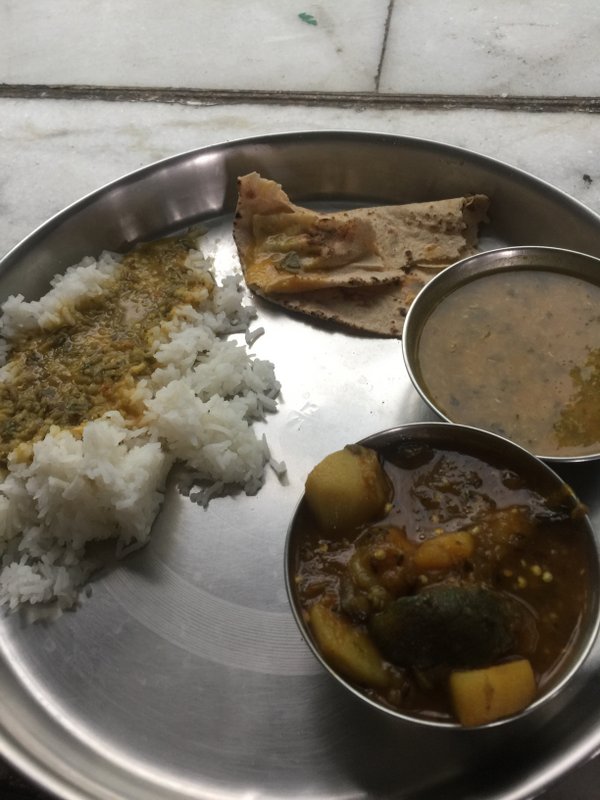
       Breakfast                                                                Lunch
  

          Meal schedule                                                                                               Dining Hall

Quite a few of the ladies were not first-timers and it was good talking to them and getting a peek into what was ahead for me. One of the first things we learnt was that the Silence period would be over on the 9th day of the programme so we could connect with family over the phone a day earlier than expected. 
           

         Noble silence                                                              Timetable

The ‘Mauni’ or Noble Silence was to start at 6 pm, after a dinner of very tasty khichdi, over which we made friends and had conversations that became louder and louder by the minute.  For this day only, the door separating the Men’s and Women’s section of the Dining Hall was open.

The Coordinator spoke to the gathering at 6, re-affirming the rules and regulations and answering a few queries. The conclusion of his talk signaled the start of the Meditation course. The group walked up to the Dhamma Hall (the meditation centre) where cushions were laid out on the carpeted floor, 6 rows and 6 columns deep for the ladies and similarly for the men, with a section of carpet dividing the groups. All the cushions faced a large screen, and two raised seats for the male and female teacher/guide.

We were all given a tag with a number on it, called in one by one by name, and told to locate the cushion with a number matching ours. All this was done in almost total silence, except for the names being whispered.  

The session started with an introduction given by Mr S N Goenka – this was a precursor for the days to come – all instructions to the group were pre-recorded, interspersed with some chanting by Shri Goenka  himself.  The instructions were in English first, and then repeated by him in Hindi. The male guide mostly just repeated the instructions at the end, sometimes all he had to say was ‘take rest, take rest, take rest’. 

The time from 7 pm to 8.30 was allotted to a discourse by Shri Goenka, and while the Hindi discourse was projected on the screen in the Hall, those wishing to listen to him in English were instructed to walk up to another meditation hall. One of the girls had suggested that I listen to his discourses in Hindi as they were better, but I decided to first try the English, as I was a bit concerned about my ability to fully understand the complicated terminology. 

After the discourse, which covered what we would be doing the next day and some clarifications about some of the practices, we all returned to the Dhamma Hall for another half hour of meditation before retiring to our rooms at 9 pm.

The pattern for the next few days was strictly according to the timetable. The three mandatory guided meditation sessions were held from 8 to 9 am, 2.30 to 3.30 pm and 6 to 7 pm in the Hall, and for the rest of the time, depending on the instructions, we were expected to meditate either in our rooms or in the Hall. Basically, 10.5 hours every day were allocated to meditation.

 I got used to waking up at 4, washing up and being at the Hall by 4.30 and sitting there till 6 when we went straight for breakfast.  I reserved the time after breakfast for cleaning the room and a bath, a short walk, and then sitting in what became a favourite place watching the trees and a few low peaks far in the distance.  The period post lunch, from 11.30 to 1 were the toughest for me – time weighed heavily on my hands, and with nothing to do except just sit, I was very soon bored out of my wits. I really feel I would have enjoyed the process more if I had something to do with my hands for just half an hour during this break. Quite likely it was expected that meditators would use this time to catch up on their sleep but since I slept by 9.30 and got a good 6.30 hours of sleep, I wasn’t able to sleep in the day time. Also, to leave the sunny open area and spend time in the small damp room was not encouraging at all. Very often the non-guided meditation sessions and the constant sitting in a darkened room became a bit too much for me, and I would get out of the Hall to take a walk or sit in the open. I saw quite a few of the participants doing the same thing. Since the silence was maintained anyway, I suppose we were not breaking any rules.


                   My favourite space

                Path to the Dhamma Centre


Through out the next few days, the monkeys really proved to be the best entertainment for us – they would arrive in gangs, making their way overhead, jumping from the trees onto the hard plastic sheets that were laid out as roofs to over the paths connecting the various buildings, and swinging down to the grassy areas to sun themselves. It was really funny to watch how they would walk right up to any lady sitting on the grass, even reaching out to touch her if she didn’t immediately move away.  That touch was enough to send the lady scuttling away, and was the signal for the rest of the gang to come and settle down. The grooming session was really a sight to see, and it was made more hilarious by the fact that this break is when most of the participants could be seen grooming themselves.


The Meditation practice:
On the first day, we were instructed to concentrate on the breath moving in and out of our nostrils, without in any way actively changing the pattern, but observing the process. The mind would tend to wander all over the place and we were instructed to try and bring the focus back to the breath, without feeling any irritation about not being able to control our minds. The focus for the next three days was basically on watching the breath, first at the nostrils, then up the nasal path, and finally only at the space between the upper lip and the nostrils. It was all about learning to observe rather than being a participant by focusing on a tiny part of our body.   On the fourth day, the actual Vipassana process was taught – this involved focusing our mind on every part of the body one by one, starting with the fontanel at the top of the head and ending at the toes, and then repeating the process in reverse order.

By the sixth day, when we had learnt to move our focus from part to part, we were advised to allow the flow of thought to cover more than one part, watching the sensations at each spot. and then finally the whole body at a time. The process then became to allow the ‘dhara pravaah’ to travel up and down the body once or twice, and then to focus on each part of the body and then to repeat the entire process – basically alternating between the full body and individual parts. It was a very powerful experience and I could really feel the warmth spreading from the top of my head to my toes. 

On the final day, we were taught the process of Mitta – spreading goodwill and wishing the benefits of our meditation to be spread to our family and friends and humanity at large.  Unlike Vipassana where we internalize all our feelings, this involved imagining all the goodwill spreading outwards from us.


Vipassana as a practice/concept:

The idea was that every sensation in our body was a physical depiction of our experiences, whether pleasant or unpleasant.  The pleasant sensations kept us rooted to this world, thanks to the desire to feel more such pleasures.  Similarly the disgust for unpleasant thoughts or feelings prevented us from rising above the unpleasantness in our lives, thereby slowing our steps to Moksha or Nirvana.

The word that was constantly repeated as the perfect feeling to have was equanimity – this would help us to watch pleasant and unpleasant sensations in a balanced manner, not reacting to either type of sensation. Each time we allowed ourselves to watch a sensation without reacting to it, it tended to go away from our body along with the feelings behind the experience.

This would help us understand that every thing in this world is impermanent (Anicca – Pali word), and passes away, with or without any intervention from us. The human body, like everything in nature, is made of tiny atoms and there is constant breaking down and reconstruction at the cellular level, leading to this impermanence.

To quote from http://www.vridhamma.org/The-Experience-of-Impermanence-through-Vipassana - The great Vipassana meditation teacher, Sayagyi U Ba Khin, wrote: "Impermanence (anicca) is, of course, the essential fact which must be first experienced and understood by practice." Anicca is a gateway, an opening. The complexity and multiplicity of the phenomena of the world can appear like a thicket, but as a person walks the path of Vipassana meditation, suddenly there is an emergence from the tangle. Anicca is the clearing. U Ba Khin wrote: "Anicca is the first essential factor-for progress in Vipassana meditation, a student must keep knowing anicca as continuously as possible." The pali word anicca is translated into English as impermanence or change. But anicca is not merely a concept. Far more, it is a sign, a marker like the stone cairns a pilgrim encounters on one of those cloud-hugging paths in the Himalayas, signposts to indicate the trail that other true pilgrims have blazed. Anicca is a word-indicator that points to a fact of reality beyond any concept: the ceaseless transformation of all material in the universe. Nothing is solid, permanent, and immutable. Every "thing" is really an "event." Even a stone is a form of river, and a mountain is only a slow wave. The Buddha said, sabbe sankhara anicca-the entire universe is fluid. For the practitioner of Vipassana, anicca is a direct experience of the nature of one's own mind and body, a plunge into universal reality directly within oneself. "Just a look into oneself", U Ba Khin wrote, "and there it is-anicca."

Afterwards :

By the afternoon of day 9,  after Mitta, the period of Noble Silence ended, though the two Meditation sessions would continue, and silence was to be maintained in and around the Meditation Hall. Along with being able to talk to each other, we were also permitted to access our phones and other belongings. It was wonderful to be able to talk to the family again, and to actually be able to read.

There was a lot of chatting and lunch was a very noisy affair – actually too noisy after the long silence.  The chatting carried on late into the night. The next morning, some of us helped to clean up the Meditation Hall, and the store rooms, and prepare the place for the next Vipassana programme. It was very relaxing to be actually doing some strenuous physical work. We then packed up and left the rooms, which had been our home for 10 days. This was followed by a walk down to Mcleodganj, and a noisy lunch with 8 friends. A Whatsapp group was quickly formed, and photos shared. While the group then split up to go shopping, I picked up some tiny gifts for the family and then headed back to the Centre.


 I had a  wonderful hour of meditation at the Tushita meditation centre next door, and then went down to a café called Morgan’s Place which turned out to actually be Murugan’s place (!) to read in peace. The feeling of having achieved something really difficult stayed with me as I watched the Triund peak in the distance.


                    Morgan’s Place

                    Triund from Morgan’s place

Vaishali turned out to be my co-passenger on my return too. The bus ride back to Delhi was uneventful for the most part till we then got stuck in a traffic jam near Ashoka Univ, Sonepat, for almost 2 hours. It was wonderful reaching Usha’s place finally.

I do not have a specific time for meditation but I feel wonderful when I do manage to spend a few minutes in silence. Vipassana, instead of becoming a distinct activity, seems to have become a part of me, and that, I think, is exactly how it should be.

Friday, June 2, 2017

Music medley

This write up on our music collection was published in the Hindu's Open Page on May 28th and the link is here.

I had enjoyed cleaning up our bookshelves, so I decided to sort out the music cassettes. Thanks to YouTube and multiple Internet links, we haven’t been buying music CDs or cassettes for a while now, but the collection we do have is a treasured one. And we are one of the few families that still own a working cassette player.
Sorting out the cassettes was like a trip down Nostalgia Lane. ‘The Call of the Valley’ was the first cassette my husband bought to play on the tiny tape recorder purchased with his first salary. It rested right next to a wonderful jugalbandi between Balamuralikrishna and Bhimsen Joshi, flanked by the glorious Chandraghanta by Pandit Jasraj at one end and Ustad Amjad Ali Khan’s album for young children at the other. Both our sons had grown up listening to that album so many times. Another favourite I found nestling next to Chandraghanta was the album of duets by Bhimsen Joshi and Lata Mangeshkar – what a hit Baaje Muraliya used to be with the family. Pandit Ajoy Chakraborty and M.S. Subbulakshmi were next to each other, and judging by their photographs on the cassette covers, Sudha Raghunathan, Ashwini Bhide and Veena Sahasrabudhe were really young when their music engulfed our home.Jazzmine by Ravi Shankar had been bought with so much pleasure after Asiad 1982 in Delhi. The all-time favourite has always been of Pandit Jasraj and Kavita Krishnamurthy singing Sumiran Kar Le , with L. Subramanian accompanying them on the violin. What a veritable storehouse of music some of our taped 90-minute cassettes were — Kishori Amonkar singing with Balamuralikrishna, Kumar Gandharva’s nirgun bhajans, Chitti Babu, Shobha Gurtu...
Shubha Mudgal was set between the classical and the light music section, as were the Colonial Cousins. The Beatles were in the ‘light’ section, followed by Pink Floyd. The album Thriller with its attractive cover was bought at the height of Michael Jackson fever, and Apache Indian was an addition that was made with trepidation. Led Zeppelin and the Abba, Dire Straits and Boney M — our shelf was a horror story for purists, but we had listened to it all, with pleasure.
Tamil line-up
Thanks to the advent of A.R. Rahman, our collection of Tamil film songs which had initially only boasted of Thiruvilaiyadal and Thillana Mohanambal grew by leaps and bounds. Bombay, Roja, Nayagan, Thiruda Thiruda, Hey Ram …. the list grew. The Hindi versions of so many of these albums joined Swades and LagaanIndira, Thalapati, Kannathil Muthamittal and Mudhal Mariyadhai joined the ranks, providing us so many hours of listening pleasure.
The last few were the best — recordings of stories and nursery rhymes by our sons, nephews and nieces. At a time when Skype, Facetime and Google Chat didn’t exist, these cassettes were treasured as personalised messages exchanged within the family — a record of some beautiful holidays spent together.

Of books and bookshelves

This article by me was published in the Hindu's Open Page on Feb 26, 2017, and I was paid 1500/- for my contribution! The link is here.


Books and bookshelves


As a family of readers, our collection of fiction is quite eclectic, ranging from comedy to murder mysteries to fantasy and science fiction to feminist writing– basically a whole gamut of themes. We have tried to keep books of each genre together, though not entirely successfully as I found out last week. While hunting for an Alexander McCall Smith book, I realised that some of our books have found some strange shelf-mates, probably depending on which of the family members did the placing.


I finally found the book tucked away between two Tom Clancy books. Alexander McCall Smith normally shares shelf space with Margery Allingham, Agatha Christie and Dorothy L Sayers and other mystery writers, given our belief that  Mma Ramotswe would get along famously with Albert Campion, Hercule Poirot, Miss Marple and Lord Peter Wimsey.  John le Carré’s Smiley is also to be found in this shelf. 


An entire shelf is dedicated to Tom Clancy, Wilbur Smith, John Grisham and Jeffery Archer.  Maybe this was planned as the ‘fast read’ shelf, as this would explain why I found Markus Zusak’s Book Thief nestled between two of the Courtney series books. Really weighty ‘Tibetan Book of the Dead’ is also on this rack – the only explanation I can imagine is that someone tried reading it, and gave it up very fast.


P G Wodehouse shares space with Erma Bombeck.  James Herriot and his wonderful books on life as a Veterinary Doctor in rural England also find space in the same shelf, as does Gerald Durrell.  This must be our ‘Humour’ shelf.  A little further up the rack is Bill Bryson with Jerome K Jerome’s ‘Three men in a boat’ tucked in between two of his books. Kazuo Ishiguro’s ‘Remains of the Day’ also found its way next to Wodehouse  - one of us must have felt Stevens would be happy next to Jeeves, talking ‘butler’ matters.


The ‘women’ shelf has Jane Austen and I am sure she is proud to be sharing her space with Simone Beauvoir and Erica Jong. Erma Bombeck, one of whose books I found here next to Pride and Prejudice, with her irreverent sense of humour would have got along beautifully with Jane Austen, I think. Amy Tan would also be proud of her place next to her country woman Jung Chang, Jane Austen and Margaret Atwood.  Chimamanda Ngozi Adichie also occupies this space proudly. Several Indian authors could have found their place here and, Shashi Deshpande, Arundhati Roy or Anita Desai would surely be quite comfortable holding their own in such enlightened company, but I guess one of us decided they are Indian first. 


The erstwhile Indian shelf has Samit Basu rubbing shoulders with Amitav Ghosh and Chitra Banerjee Divakurni.  R K Narayan would have not minded being placed next to V S Naipaul, who once paid tribute to the author, saying he was ‘immediately enchanted’ by his early works.   Ruskin Bond has Khushwant Singh as a neighbour, possibly because of the ‘Himalayan hill-stations’ connection. I am glad he is in this section rather than with all the ‘English’ authors. 


With the Afghan-born American author Khalid Hosseini and Pakistani authors Bapsi Sidhwa and Kamila Shamsie becoming favourites, the Indian shelf has become more of an Asian shelf. Now with Elif Shafak and Orhan Pamuk joining the list of favoured authors, Turkey is also going to need a place – maybe these books will be the link between Asia and Europe in our bookshelf, just like the nation straddles Eastern Europe and Western Asia.


Thanks to the size of each book of Amitav Ghosh’s Ibis trilogy, the Asian shelf is filling up very fast and has started encroaching into other shelves – something like the way Indians themselves are permeating societies everywhere in the world.


A young friend has solved all the dilemma of making decisions about whether books should be segregated geographically or thematically by arranging his bookshelves according to colour. While this is really appealing visually, I am not exactly sure about how one would go about locating a book unless you remembered the colour of the cover!


Thanks to books going ‘walkabout’, we do spend a while locating a book, but then browsing along the racks is a pleasure too! Maybe colour-coded bookshelves are a good idea – something like the Shuffle option for music – you never really know what comes next.


Wednesday, November 25, 2015

Let's get our priorities right!

There's growing unrest in the world, the situation in Syria, Turkey shooting down a Russian jet, crimes against women on the rise (at least more getting reported and publicised), the Taliban flexing its muscles again, the ISIS and the concern about why it is attracting educated youngsters - but all that we can talk about is why Aamir Khan and Shahrukh Khan called us intolerant.

Of course we are not intolerant - we are only making this headline news, telling 'them' to leave the country, exhorting people to not watch their movies - seriously!!!! Of course there is no room for debate or discussion; of course we can not allow people to think for themselves! What if they actually thought,  and realised that this non-issue is really not worth discussing and that we need to discuss why primary education is still not reaching every child, why we have a shortage of teachers, why so many teachers don't attend school, why.... the list could go on and on but then do we have the time? We need to discuss why actors have a mind and are daring to speak out their minds! Bring it on people - let's solve all the world's problems by addressing these 'serious' issues!

Tuesday, November 24, 2015

It's only a stone! Why am I so attached to it?

It’s only a stone – why am I so attached to it?

Think of all the people who would have slaved in the mines to unearth this – or the first person who saw it for what it was but had to give it up to the owner of the mines – how tough would it have been to give it away!

Should I be getting so attached to material things that I can actually lose sleep over the loss of it? When did I become what I had so badly never wanted to be – did accumulation and then slowly possessiveness just grow on one? Creeping in sooooo gradually that before I realised it, I had started to value the wrong things about my ring – that I was appreciating the diamond rather than the fact that it was a first symbol of when we started being able to afford things/jewellery, just for fun and pleasure, not for resale value but for sheer happiness. Is that where the problem is – was a diamond ring really giving me happiness!

It was 2.30 in the night, when I moved my hand and something sharp poked me – I realised it was a spoke of the ring which had lost its diamond! A beautiful solitaire that I was entranced by – one piece of jewellery that I actually missed when I was not wearing it. Over 10 years old, it was special to me – I had purchased  it for a very ‘reasonable’  price. What I realise is that it was not the money that was bothering me – just the fact that a beautiful thing was lost. I am not sure giving it away would be tough – I hope not!  - but the fact that it just may have fallen away somewhere, and will find its way into the garbage dump really bothered me.  As did the thought of the family’s possible reactions to the loss.

That is when I realised, yet again, that I had a special blessed life. Ravi would be shocked, and would join the search, which would be a very vague one as we couldn’t really be sure of when it fell off – definitely within the past 3 hours. That is when I realised how often I looked at it – I was sure I would have noticed it immediately, which meant I looked at my ring once almost every 10 minutes! Anyway, he would have searched – and probably thought about how I should be more careful, but seeing how upset I was, would not have voiced the thought at all. He would have promptly suggested that we go shopping to pick up a new diamond to fit the gap! Even though very careful with money, he would not have thought twice about spending on something to try and make me feel happy. But he would have continued looking into the gaps in the furniture or the corners of the rooms, just to see whether it could be located.

My mother would have made lots of noise about how sad it was, and how hard we worked to build up a collection, and how we had never harmed anyone so good things only would happen to us, and would have ended with being convinced that it would show up one day. The true optimist!

My reaction surprised me – first feeling of regret at having lost a beautiful thing was followed by disgust at myself for not having looked after it better. I kept telling myself that I didn’t need a ring, that I was blessed that the family was healthy and doing well, that I should get my priorities right, set up the Trust for adult literacy that I had been planning, stop procrastinating, But… I couldn’t sleep! I was wide awake tossing and turning, then suddenly decided to rule out the possibility of the diamond being somewhere ‘locatable’. I switched on the torch in my phone and walked through the house, scanning the floor all the time. I even looked into a carton that had been kept for disposal as I remembered putting my hand into it an hour before we slept! I could see myself even a year later, not entirely able to stop looking for it.

Walking back into my room, trying to not disturb Ravi, but unwilling to put off my search, I flashed the torch just once more inside the room, and … something sparkled back at me. I still cannot believe I found it! Am I going to stop loving it – no!! but I am going to definitely something about the Trust and other such thoughts and GET MY PRIORITIES RIGHT!

I had gone to sleep after a discussion with Shashank about contact lenses for supriya for the wedding – one of the thoughts when the missing diamond really ‘woke’ me up was to get my priorities right.  This was going to be a special time for her any way – how did it matter whether she wore glasses or not in the photographs! Shashank’s message saying he was going to leave the decision to her made me realise how much I was getting trapped by others’ vision of what a wedding should be – these two had a good thing going and I am not going to spoil it. Am looking forward to a wonderful month ahead.


Saying which, this same note would not have been written if my diamond had not been found J